
decision-guide
Duda alternatives for agencies delivering client sites with AI (2026)
Last updated: Nov 3, 2026
Quick answer
Readdy is worth considering when your agency wants AI-assisted revisions and branded client access, available on Agency Pro and higher. Dorik Agency suits a service built around client CMS editing. Keep Duda when its permissions, previews, and delivery process already work well for your team and clients.
| Situation | What to prioritise | What kind of option fits |
|---|---|---|
| You want a different page revision method | How the team makes and checks page changes | Readdy or the relevant Duda creation route |
| Customers regularly publish content | Branded CMS tasks and ownership | Dorik Agency |
| Existing Duda delivery is dependable | Customer continuity and team knowledge | Keep those projects on Duda |
| You want conversational creation within Duda | Vibe's project scope and its separation from Editor | Evaluate Vibe for suitable new work |
How do we compare the agency delivery options?
For an agency already delivering client websites, a change of builder affects both production and customer support. We compare creation methods, branded client tools, and transfer or export limits using official product, help, and plan information. Consider what your team would gain and what it would need to rebuild. Choosing a tool for a new project is a different decision from moving working sites, client access, and established routines to another platform.
What must improve before a switch is worthwhile?
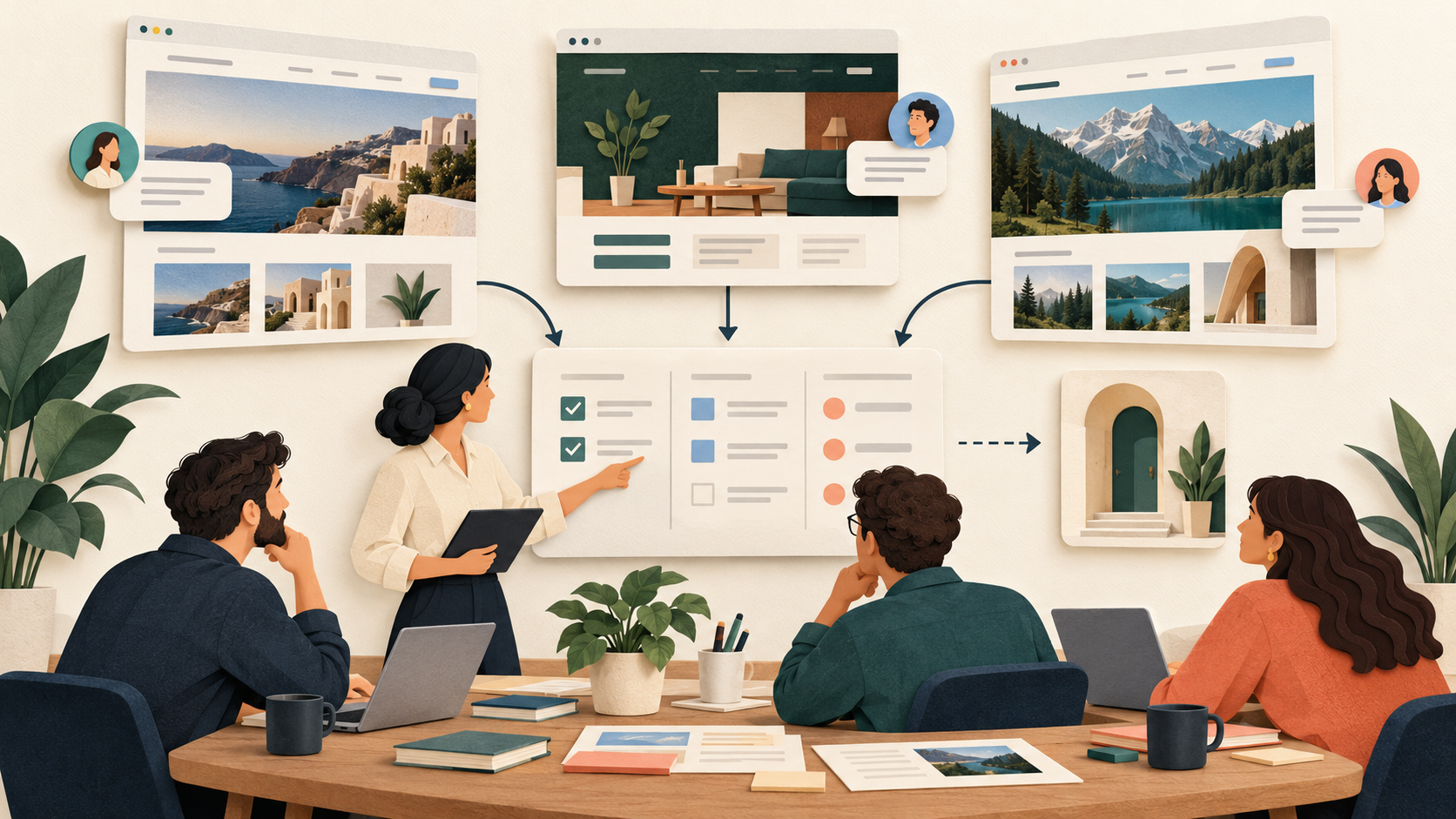
A switch is worth considering when the team can name a recurring problem, such as slow revision rounds or a client editing process that needs too much support. Start there, since replacing a builder affects the people who use it as well as the pages it produces.
Is the problem creation or client service?
If the team wants conversational site creation, Duda Vibe is one option alongside Readdy and Dorik. Vibe creates websites and web applications through prompts, with visual editing and code access. It is in beta, which matters when deciding which client work to place on it and how to support that work. Compare it with the agency's current Editor workflow as well as with another vendor.
If the problem concerns client access, compare the actual client task. Duda offers a white-label login, builder, dashboard, and preview tools. Readdy's white label website builder supports branded login and client-facing identity with separate platform and site domain settings. Dorik Agency provides a white-label CMS dashboard. Decide which interaction needs to improve before replacing a familiar customer interface.
Which project type do you have now?
Duda Vibe and Editor 2.0 are distinct products. A Vibe project cannot be transferred into Editor 2.0, and an Editor 2.0 website cannot be transferred into Vibe. Record which route each current project uses and what the proposed destination will be.
For an existing Editor 2.0 site, using Vibe means planning a separate project rather than turning on a different editing mode. Decide which content and functions that project needs, and allow time to rebuild and check them. The same inventory is useful when moving from Duda to another platform.
What must customers continue doing?
List the client's recurring work: editing service information, publishing articles, reviewing changes, or using an account-based tool. An agency that manages every edit has different needs from one whose clients maintain their own content. Preserve the tasks that customers already understand unless the replacement provides a useful change.
Ask which data or connected services support those tasks. A public page can be rebuilt from approved content; an application with stored records needs more than a visual reproduction. If the proposed move affects data, accounts, or business logic, bring the responsible technical person into the estimate before presenting a fixed migration price.
How much rebuilding is involved?
Use a project inventory with four decisions: retain, rebuild, replace, or retire. A service description may be retained as content. A form needs a working destination. A layout may be rebuilt. An obsolete page may be retired. This gives the account team a concrete basis for explaining the move to the client.
Include the less visible work: public URLs, client login instructions, stored assets, and external services. Pages can look alike while handling forms, accounts, or connected services differently. The migration estimate should reflect the complete service the customer expects to continue using.
Who maintains the destination?
Choose the long-term editing arrangement before selecting the handover route. A client who continues using a hosted builder has a different responsibility from a developer taking an exported code project. Identify the person who approves changes, the person who publishes them, and the person who handles technical questions.
Before adding another builder, make sure someone can support the clients who will use it. Different tools can suit different projects, but each adds an editing process for the team to learn. Keep that support work in the decision alongside any improvement in page creation.
How do white label, client management, AI, and price compare?
Readdy and Dorik Agency offer different approaches to client delivery, while Duda can still suit both existing and new work. Compare the packages below against the editing and client tasks your agency needs to support.
| Criterion | Readdy | Dorik Agency | Duda White Label |
|---|---|---|---|
| White label | Client-facing branding, login, platform and site domains on Agency Pro+ | Branded CMS dashboard and agency identity | Branded login, builder, dashboard, previews, and communications |
| Client work | Branded client entry and project experience | CMS dashboard and collaborators for content work | Client workspace with role-based permissions and previews |
| AI generation | Generate from a brief or supported reference, then revise with AI or direct edits | AI site generation and no-code editing | Website builder plus conversational Vibe projects; Vibe is in beta |
| Price and billing basis | Agency Pro or higher; choose the billing term on the Readdy pricing page | USD $99 monthly, or $79/month billed as $948 annually | USD $199 monthly, or $149/month with annual billing |
| External hosting | Project ZIP from Starter; deploy and configure connected services separately | Static-site export; CMS sites are excluded | Eligible published Editor-site export from Agency; Vibe has no Site Export |
Readdy and Duda both offer agency-branded client access, while Dorik Agency provides a branded CMS dashboard for content work. Compare the client's recurring tasks, such as reviewing changes or publishing an article, rather than assuming these are exclusive strengths. For external hosting, Readdy project downloads and Duda's eligible Editor-site exports are different from operating a hosted CMS; Duda Vibe and Dorik CMS do not support those same site-export methods.
What do Duda and its alternatives cost for client delivery?
Duda Basic is USD $25 monthly or $19 per month on annual billing; Team is $39 or $29; Agency is $69 or $52; White Label is $199 or $149. The first amount in each pair is month-to-month billing, and the second is the monthly equivalent with an annual commitment. Basic and Team include one site subscription, while Agency and White Label include four. A lower platform price does not buy the White Label experience: that branding is available on White Label and Custom.
For White Label, $149 per month billed annually means $1,788 for the year, compared with $199 on monthly billing. Additional published projects and chosen business features can increase the total. Vibe shares the included site-credit pool; once those credits are used, a Vibe project needs its own subscription. Calculate the intended mix of live projects rather than treating every draft as a separately included published website.
Dorik Agency is $99 month to month or $948 annually, shown as $79 per month with annual billing. Compare that billing commitment with the Duda plan you need. For Readdy, use Agency Pro or higher pricing for the selected term and include the client sites and features required by the service. The feature table identifies the relevant packages; the agency still needs a complete budget for its actual portfolio.
Rebuilding pages, collecting missing content, and teaching clients a new editor all take time beyond the subscription cost. Estimate that work for one real project before applying the calculation to the whole portfolio.
For each client, list the pages, forms, content, and functions that need a new home. Record which materials the agency already has and which require customer input. Include a review round for the replacement and a live-domain check. If the customer must learn a different editing process, budget for that handover too.
Decide what happens to incoming work during the switch. If both the old and new sites can collect enquiries, the business needs to know where to look and which system is authoritative. Keep the existing site available until the accepted replacement and its operating arrangements are ready. Agree when the domain will change and who will check the first enquiries sent through the new site.
Dorik Agency's CMS offering needs a specific handover agreement. Its code export route applies to static sites, not a complete CMS site. If the customer expects a downloadable publishing system for another host, resolve that requirement before selecting the CMS service. Do not infer CMS portability from a general export feature label.
Duda Site Export is available from the Agency plan for published Editor sites, up to 1 GB, and only account owners or staff can use it. The ZIP contains frontend files, with exclusions for dynamic features, membership data, and other services; contact forms need replacement work. Vibe projects cannot use Site Export. Check the site type and the client's required functions before treating export as a complete move to another host.
Staying with Duda makes sense when clients can review, edit, and use their sites as intended and the team can support them comfortably. A new builder should resolve a specific problem worth the rebuilding and training work. You can keep those existing sites on Duda while choosing Readdy or Dorik for new projects with different requirements.
When is staying with Duda the better decision?
Duda remains a strong fit when clients already use its permissions, previews, and content process comfortably, or when an existing Editor site would need considerable rebuilding elsewhere. If the missing feature is conversational creation, Vibe is available within Duda, subject to its beta status and separate project limits.
Group current clients by what their websites do. Public service sites, regular publishing sites, and account-based tools may need different destinations. Pick a project whose requirements the proposed platform can support, with a client who can provide the necessary content and review decisions. Keep the rest of the portfolio on its existing arrangement while that delivery is completed. The guide to choosing a platform for multiple client websites provides a broader framework for those recurring editing, access, and handover tasks.
After the move, update the agency's internal instructions with the actual page, form, domain, and support tasks that changed. The account team should know which address to give the customer and which questions require technical help. Use that record to estimate another similar project. A successful move for one service website should not become an assumption that an unrelated application or CMS will require the same work.
How does Readdy fit a branded client service?
Readdy is worth trying for projects where much of the work arrives as written feedback: bring a service higher on the page, shorten an introduction, or focus a section on a different audience. The team can use that feedback to request AI revisions, then correct precise details directly. Start with the client's approved offer and images so each revision has a clear reference.
For agencies that want clients to return through an agency-branded login, Readdy's white label website builder features are available on Agency Pro and higher. You can configure the client-facing name, logo, favicon, and login experience. Keep that workspace branding distinct from the client's public website, which should still represent the client's business.
Readdy's white label website builder separates platform access from published-site domain configuration. Branded domains require DNS access. If invitations or supported notifications must use an agency sender, configure a verified Resend account and sending domain. The White Label email flow allows sender details and subjects to change; the message body is not fully editable there. Allow for that setup when introducing branded invitations to clients.
For a project involving accounts or saved data, Readdy Backend provides a database, authentication, functions, and secrets from Starter. Define which customer task you will rebuild and what data it uses before moving records. Local debugging, logs and monitoring, migration management, and backup and restore are outside the Functions module, so include any required operational tools in the technical plan.
Code export is available from Starter as a ZIP containing the current project. If a developer will host it elsewhere, agree who will deploy it, reconnect services, and maintain that copy. Download again after further AI edits, and install dependencies with npm install for local use. The download provides project files; customer records and connected services still need their own transition plan.
Should your agency switch from Duda?
Try a Duda alternative on a new project before planning a wider move. Readdy combines AI-assisted revisions with branded access on Agency Pro or higher; Dorik Agency provides a branded CMS dashboard for ongoing content work. Existing Duda sites can stay where they are if clients and staff are comfortable with the setup. Use the first project to judge the revision process, handover work, and support it actually requires.